
Quick answer: Product-led content is content that uses the SaaS product itself as the demonstration of the concept being taught. A guide to invoicing automation written by a billing SaaS shows the product solving the invoicing problem in the same article that teaches invoicing. The category was popularized by Animalz and refined by SaaS teams like Ahrefs, ConvertKit, Figma, and Notion. Product-led content typically outperforms generic content by 3 to 5 times on conversion because every educational moment is also a product demonstration. The discipline that scales it is editorial: showing the product without selling it, and trusting the reader to make the connection.
Most B2B SaaS content programs separate education from product. The blog post teaches the concept; the demo page sells the product; the two are linked by a CTA at the bottom of the post asking the reader to switch contexts. Product-led content collapses the separation. The post teaches the concept by walking through the product solving the problem, which means the reader who finishes the article has already seen the product work.
The category was named and developed by Animalz starting around 2018, and the canonical examples have multiplied since. Ahrefs writes “how to do keyword research” using Ahrefs. ConvertKit writes “how to launch a newsletter” using ConvertKit. Figma writes “how to run a design critique” using Figma. The pattern: the SaaS demonstrates the product solving the problem in the same article that defines the problem. The reader learns and evaluates the product simultaneously.
Building product-led content for your B2B SaaS?
Oraya Studios scopes product-led content as part of fractional engagements where the brief writer works directly with the product team to identify the demonstration moments worth building content around.
Recommended reads from this site
- SEO content marketing for B2B SaaS strategy guide
- Bottom-of-funnel content for SaaS
- Keyword research for B2B SaaS
- How to write a SaaS content brief
- What does a fractional content marketer do
What product-led content actually is (and is not)
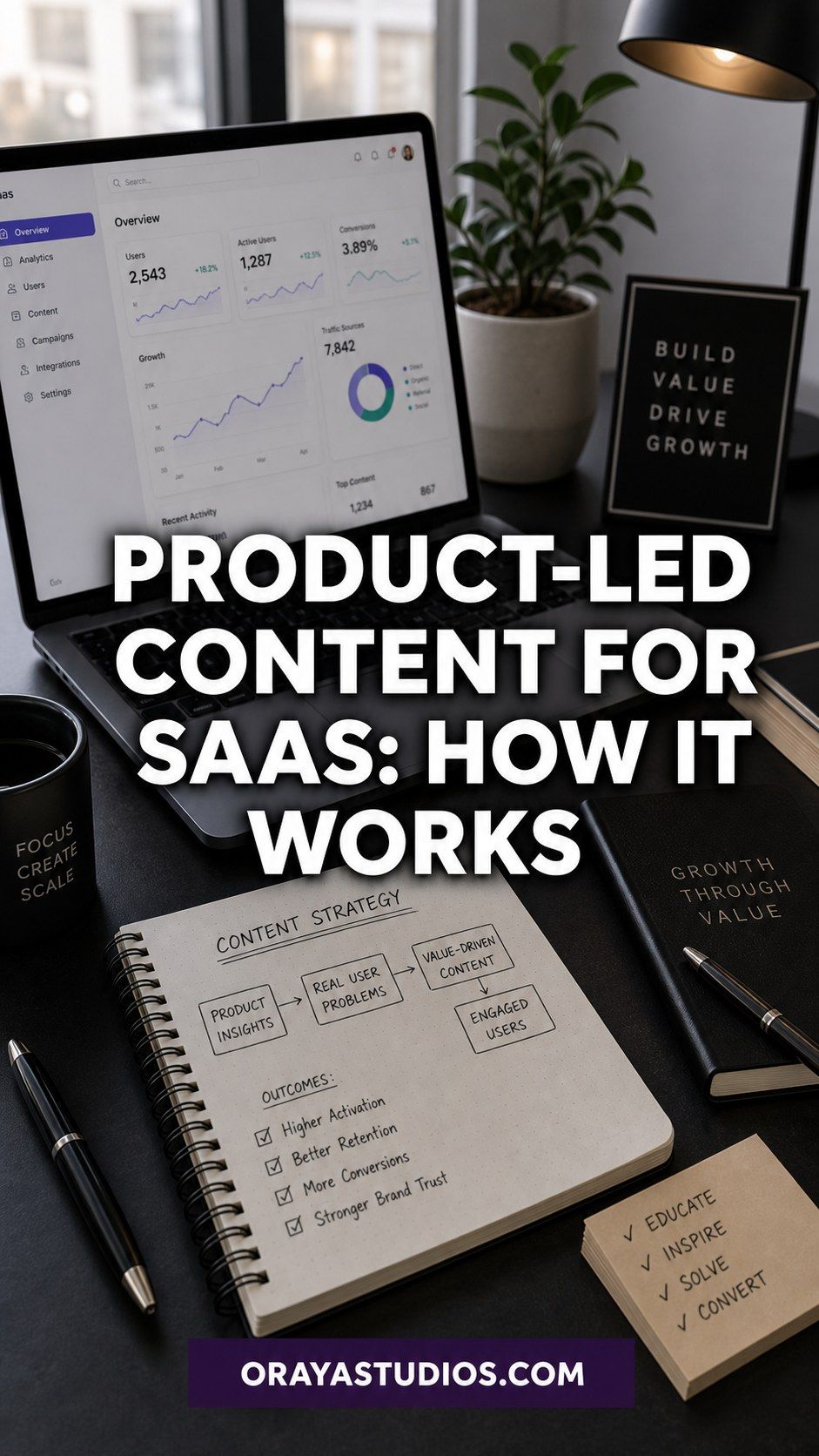
Product-led content is content where the product solves the problem the article teaches. The category has a tight definition. A guide to “how to write a sales follow-up email” that uses the SaaS’s email sequencer to send the example follow-up is product-led. A guide to “how to write a sales follow-up email” with a CTA to the SaaS at the bottom is not.
Read this also: Fractional Content Marketing for SaaS
The distinction matters because the conversion mechanics differ. Generic content with a CTA asks the reader to make a context switch: stop learning, start evaluating. Product-led content removes the switch by making the evaluation part of the learning. By the time the reader reaches the end, the product has demonstrated itself across 4 to 8 screenshots, workflows, or example outputs.
Product-led content is also not the same as product marketing content. Product marketing content describes what the product does (“our email sequencer supports A/B testing, conditional logic, and behavioral triggers”). Product-led content shows the product solving a specific user problem in the context of that problem (“here is how to A/B test a sales follow-up sequence; here is the test running in our product; here are the results we measured”). The framing is the difference between a feature list and a demonstration.
Why product-led content outperforms generic content for SaaS
The conversion advantage comes from three structural mechanics.
Read this also: SaaS Content Marketing Budget
Mechanic one: every educational moment is also a product demonstration. The reader does not need a separate trial to evaluate the product; the trial is embedded in the article. By the time the reader finishes a well-built product-led piece, they have seen the product solve the specific problem they came to research, which moves them from problem-aware to vendor-aware inside a single reading session.
Mechanic two: the content matches the search intent more tightly. A buyer searching “how to do keyword research” wants to learn keyword research, not read marketing copy about a keyword research tool. Product-led content gives them what they searched for (the how-to) and what they did not yet know they needed (a tool that operationalizes the how-to). The intent match raises engagement, time on page, and the LLM (large language model) citation signal that increasingly matters in 2026.
Mechanic three: the content is structurally harder for competitors to copy. A competitor without the same product cannot write the same article. The defensibility is permanent because the content’s value lives in the product demonstration, not just the writing. Generic content is commoditized within months; product-led content stays valuable as long as the product does.
The economic effect: product-led content typically converts at 3 to 5 times the rate of generic informational content for B2B SaaS, and produces longer-tail value because competitors cannot replicate the format. Animalz’s product-led content research documented the conversion advantage across 30+ SaaS programs they ran.
The canonical examples: who does product-led content well
Five examples worth studying for B2B SaaS marketers building product-led programs.
Read this also: How to Hire a Fractional Content Marketer
Ahrefs. Almost every Ahrefs blog post uses the Ahrefs product as part of the demonstration. “How to do competitor analysis” walks through Ahrefs Site Explorer. “How to find keyword opportunities” walks through Ahrefs Keywords Explorer. The reader who finishes an Ahrefs blog post has seen the relevant feature work in the context of their actual problem. The Ahrefs blog is the canonical reference for product-led content at scale.
ConvertKit (now Kit). Email marketing content shows ConvertKit’s product solving the email problem. “How to launch a newsletter” walks through ConvertKit’s newsletter setup; “how to segment your email list” walks through ConvertKit’s segmentation; “how to write a welcome sequence” walks through ConvertKit’s automation. The pattern is consistent and the conversion is documented in their growth case studies.
Figma. Design education content uses Figma to demonstrate the concepts. “How to run a design critique” walks through Figma’s commenting and presentation features. “How to build a design system” shows the design system being built in Figma. The reader learns design practice and evaluates Figma simultaneously, which is one structural reason Figma converted designers from Sketch and other tools faster than traditional marketing would have.
Notion. Productivity and knowledge-management content uses Notion to demonstrate the workflow. “How to run a content calendar” shows the calendar built in Notion. “How to structure a personal wiki” shows the wiki built in Notion. The product becomes the demonstration of the productivity philosophy the content teaches.
Webflow. Web development content uses Webflow as the demonstration. “How to build a marketing site” shows the site built in Webflow. “How to design a landing page” shows the page built in Webflow. The pattern: the product is the example, not a footnote.
When product-led content fits and when it does not
Product-led content is not the right approach for every B2B SaaS content piece, and forcing it where it does not fit produces awkward writing that converts worse than honest generic content.
Product-led works well when: the SaaS solves a workflow problem that maps to specific screens or features (Ahrefs solves keyword research; ConvertKit solves email automation; Figma solves design collaboration). It works less well when the SaaS solves a problem at a layer above any specific screen (compliance platforms, security tools, infrastructure SaaS that operates invisibly under user workflows).
Product-led also requires the SaaS’s product team to be involved in content production. The writer cannot credibly demonstrate the product without product knowledge, which means the content function needs working relationships with engineering, product management, or customer success. Content teams operating in isolation from product cannot ship product-led content credibly; the technical accuracy gaps show up immediately to product-knowledgeable readers.
The honest filter: if the SaaS cannot produce a 3-to-5-screenshot walkthrough of the product solving the article’s central problem, the article is probably not a product-led candidate. Force-fitting the format usually produces marketing-flavored generic content that converts worse than committing to either honest generic content or honest product marketing.
Want product-led content briefs that work with your product team?
Oraya Studios runs product-led content workshops as part of fractional engagements. Three to five candidate topics identified per quarter, briefs written in coordination with product, drafts reviewed against actual product accuracy.
How to write product-led content that does not feel like marketing
The single discipline that separates product-led content that works from product-led content that fails is editorial restraint. The writer shows the product solving the problem; the writer does not narrate why the product is great. The reader is trusted to draw the conclusion from the demonstration.
The pattern that works in practice: open with the user problem (in the user’s language, drawn from sales calls and Reddit threads, not in product-marketing language); explain the conceptual approach to solving the problem (the framework or methodology that applies regardless of which tool the reader uses); walk through the specific implementation in the SaaS’s product (4 to 8 screenshots showing the workflow); show the outcome (what the user gets after running the workflow); close with the broader principle the demonstration illustrates.
The pattern that fails: open with the product (jumping straight to features), explain why the product is great (marketing voice), show the product solving the problem (but with feature-list framing), close with a CTA-heavy push. This format reads as marketing in disguise and the reader bounces or skims, which destroys the conversion advantage product-led content should produce.
The voice that works is closer to a senior practitioner walking a junior practitioner through a problem they solved. The product is in the walkthrough because the senior practitioner uses it, not because the article is selling it. The implicit endorsement is materially more persuasive than explicit endorsement.
Distribution and SEO implications of product-led content
Product-led content has SEO and distribution dynamics that differ from generic content.
On the SEO side: product-led content tends to win comparison and use-case keywords (where buyer intent is high) and lose pure informational keywords (where AI Overviews now answer fluently without a click). The strategic implication: prioritize product-led format for keywords in the commercial-investigation and transactional intent buckets. For pure informational keywords, generic guides without product demonstration often outperform product-led versions because they match the SERP (search engine results page) expectation of educational content.
On the distribution side: product-led content is structurally harder for competitors to share but easier for users and customers to share. The asymmetry produces a different distribution dynamic. Product-led pieces typically get less competitor or industry-publisher amplification (because amplifiers do not want to highlight a single vendor) and more user amplification (because the content actually helps the user do their job). The compounding effect is slower in the first 90 days and stronger over 12 to 24 months.
On the AI citation side: product-led content with original screenshots, specific workflows, and named outcomes tends to get cited by AI engines as the canonical answer to specific use-case queries. The original data the SaaS produces from operating the product is exactly the type of citation-worthy content AI engines prioritize. Bernard Huang of Clearscope frames this as the ownable lanes principle: the SaaS that documents specific workflows in specific contexts becomes the cited authority on those workflows.
Measuring product-led content performance
The performance measurement for product-led content adds two layers beyond generic content metrics.
Layer one: the standard SEO and engagement metrics (rankings, traffic, time on page, scroll depth, internal navigation). Product-led content usually outperforms generic content on time-on-page and scroll-depth metrics because the screenshots create natural reading pauses that increase engagement.
Layer two: trial signup or demo request conversion specifically attributed to product-led content. The key metric is the conversion rate of product-led pieces versus generic pieces in the same content library. Most B2B SaaS that run both formats find product-led pieces converting at 2.5 to 5 times the rate of generic pieces on the same kinds of keywords.
Layer three (often overlooked): product activation rate of users who came in through product-led content. Users acquired through product-led content typically activate faster (within their first session or first three sessions) because they already saw the product workflow before signing up. The activation-rate advantage compounds the conversion advantage because activated users retain materially better.
Want product-led content built into your SEO content strategy?
Oraya Studios scopes the product-led content opportunity during the first 30 days of a fractional engagement. We identify 8 to 15 candidate topics where product-led format will outperform generic, and write briefs the team can execute against.
Frequently asked questions
Is product-led content the same as product marketing content?
No, the framing is different. Product marketing content describes what the product does. Product-led content shows the product solving a specific user problem in the context of that problem. The difference shows up in how the reader experiences the content: product marketing reads as marketing; product-led reads as a useful tutorial that happens to use the SaaS’s product as the working example. The conversion mechanics also differ; product-led typically converts at 2.5-5x the rate of product marketing on equivalent keywords because the framing matches search intent more tightly.
Can early-stage B2B SaaS produce product-led content effectively?
Yes, often more easily than later-stage SaaS because the product is smaller, the use cases are clearer, and the founder usually has direct product knowledge to draw on. Early-stage SaaS at $0-$3M ARR can produce strong product-led content with 1-2 founder-written pieces per month focused on the SaaS’s strongest use case. The constraint at early stage is usually editorial bandwidth, not product complexity. Later-stage SaaS at $15M+ ARR sometimes struggle because the product has expanded to cover many use cases and identifying the right one to feature per article becomes harder.
What is the right ratio of product-led to generic content?
Roughly 40 to 60% product-led for B2B SaaS at $1M-$15M ARR where the product solves a workflow problem mappable to specific screens. The rest of the content library (40-60%) should be generic guides that build topical authority, capture informational keywords where AI Overviews have not yet eliminated click-through, and provide context for the product-led pieces. SaaS that try to make 100% of their content product-led usually produce awkward pieces where the product fit is forced; SaaS that produce 100% generic content miss the conversion advantage product-led offers.
Who writes product-led content well: in-house, agency, or fractional?
In-house writers and senior fractional content marketers typically produce product-led content better than agencies. The reason is product context: in-house writers and fractional partners who work with the team for 12+ months build the product knowledge required to demonstrate workflows credibly. Most agencies operate too far from the product team to write credible product-led content; their product-led attempts often read as marketing-flavored screenshots. The exception is agencies that specialize in a single B2B SaaS vertical and have deep product context in that vertical.
How long does product-led content take to write compared to generic content?
Roughly 30-50% longer in research and writing time, and the brief is materially longer because it includes the product workflow specification. A generic 2,500-word guide might take 12 hours total (research, writing, editing); the equivalent product-led piece typically takes 16-20 hours including the product walkthrough screenshots and product-team review. The conversion advantage usually returns the time investment within 2-3 months of publication on the right keywords.
Key Takeaways
- Product-led content uses the SaaS product as the demonstration of the concept being taught. The reader learns and evaluates the product simultaneously.
- Canonical examples: Ahrefs writes keyword research content using Ahrefs; ConvertKit writes email content using ConvertKit; Figma writes design content using Figma.
- Product-led content typically converts at 2.5-5x the rate of generic content on equivalent keywords (Animalz research) because the framing matches search intent more tightly.
- Product-led requires three conditions: a SaaS solving a workflow problem mappable to specific screens, product team willingness to engage with content, and editorial restraint that shows the product without narrating its greatness.
- Best ratio for $1M-$15M ARR B2B SaaS: 40-60% product-led content for commercial-investigation and transactional keywords, 40-60% generic content for informational keywords and topical authority.
- Product-led content takes 30-50% longer to write but produces longer-tail value because competitors without the same product cannot replicate the format.
Wrapping up
Product-led content sits at the intersection of editorial discipline and product knowledge. The discipline is editorial: showing the product without selling it, trusting the reader to draw the conclusion from the demonstration. The knowledge is product: writing accurately about workflows and outcomes only the in-house or fractional content lead with deep product context can produce.
The teams that hold both disciplines produce some of the highest-converting content in B2B SaaS marketing. Ahrefs, ConvertKit, Figma, and Notion are the canonical examples because they ran product-led content as the primary format for years, not as an occasional experiment. The compounding effect over 24 to 36 months is what makes product-led content one of the most durable competitive moats a B2B SaaS content program can build.
For most B2B SaaS in the $1M to $15M ARR band, the practical recommendation is to identify 8 to 15 product-led topic candidates per quarter, write briefs that include the specific product workflow each piece will demonstrate, and run the format alongside generic content rather than instead of it. The right ratio depends on the SaaS’s product surface, but the framework holds: product-led format for the conversion-intent content, generic format for the topical authority content. Both jobs matter; the discipline is matching the format to the job.