
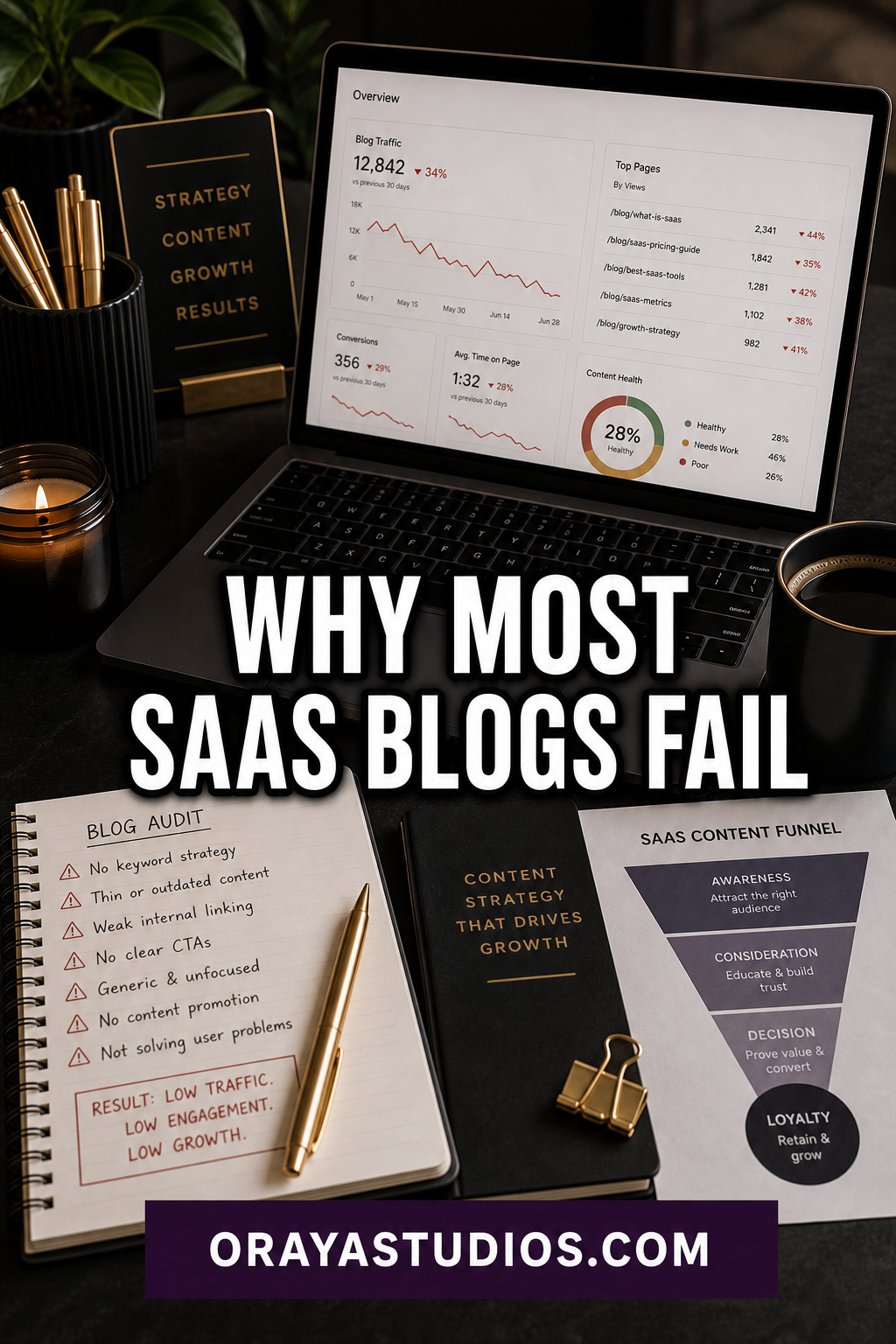
Quick answer: Most SaaS blogs fail for five structural reasons: they target informational keywords their buyers do not actually search, they confuse traffic with pipeline, they have no topical authority, they ignore the AI search era, and they treat the blog as a publishing channel instead of a sales asset. The patterns repeat across audits regardless of industry. SaaS companies spend up to $1.09 million per year on content marketing and only 29% rate the strategy as effective (5WPR’s 2026 SaaS Content Paradox). The problem is rarely effort. It is structural.
SaaS companies in 2026 are spending more on content marketing than at any point in the discipline’s history and getting less in return. The numbers from 5WPR’s 2026 SaaS Content Paradox research are clarifying: $342,000 to $1.09 million annual content spend at the median, 29% of teams rating their strategy as effective, 47% not measuring ROI at all. A founder who feels the program is broken is statistically correct most of the time.
The patterns that drive the failure repeat across SaaS audits regardless of vertical, ARR (annual recurring revenue) band, or team size. Five structural failures explain almost every underperforming B2B SaaS blog. The first part of fixing the problem is recognizing which patterns apply to the SaaS in question. The second part is the targeted intervention each pattern requires. This guide walks through all five with the specific diagnostic, the underlying cause, and the action that resolves it.
Want to find out which of the five patterns is costing your SaaS pipeline?
Oraya Studios SEO audits document the specific patterns active in your content library, the priority of fixes, and the revenue-attributable impact of each. Output delivered within 14 days.
Recommended reads from this site
- Why does my SaaS need SEO
- Content marketing vs paid ads for SaaS
- Is SEO worth it for SaaS startups
- Do SaaS companies need content marketing
- Evaluating a B2B SaaS content agency
The real numbers: how bad is it
The baseline data is more bracing than most founders realize when budgeting. Ahrefs’ analysis of billions of pages found that 96.55% of all content gets no traffic from Google. The 3.45% that does is concentrated at companies with deep topical authority, original data, and integrated SEO and content programs. For B2B SaaS specifically, the failure rate is similar: most published blog posts produce zero rankings, zero AI citations, and zero pipeline contribution.
The cost side is documented. 5WPR’s 2026 research places median B2B SaaS content marketing investment between $342,000 and $1.09 million annually, with the top end usually concentrated at $5M+ ARR SaaS running internal teams plus agency support. The effectiveness rate is 29%: less than one in three teams rate their content strategy as effective.
The diagnostic question is not whether the program is healthy. The probability the program is healthy is roughly 1 in 3 across the category. The right diagnostic question is which of the five structural patterns is most active in this specific SaaS, and what the targeted fix looks like. Most founders we audit recognize themselves in at least three of the five patterns simultaneously.
Want the audit that maps the five patterns to your specific content library?
Oraya Studios SEO audits identify which patterns are active in your blog, prioritize fixes by revenue impact, and document the specific posts driving the most pipeline leak.
Pattern 1: Writing for algorithms, not buyers
The most common failure pattern. The SaaS commissioned content based on keyword research that prioritized monthly search volume, produced 30 to 80 informational guides over 12 to 18 months, and is now ranking decently for “what is” queries that produce no pipeline.
The structural cause: keyword research that started in Ahrefs or Semrush rather than in sales call recordings, support tickets, and Reddit threads. The keyword tools surface the high-volume queries because volume is the metric they sell. The high-volume queries are typically informational, which converts at a small fraction of commercial-investigation rates.
CXL’s bottom-of-funnel analysis documents the conversion math: commercial-investigation and transactional keywords convert at up to 10 times the rate of informational keywords. Yet 70% or more of typical B2B SaaS content libraries target informational keywords. The structural mismatch is the largest single source of underperformance.
The Reddit founder who summarized the pattern most clearly: “We spent 8 months writing blog posts that never ranked. We targeted ‘what is project management’ with a domain authority of 12. Meanwhile our competitor was writing ‘Asana alternatives for developer teams’ and getting high-intent traffic from week one.”
The fix: invert the intent ratio. A healthy 2026 B2B SaaS content library is roughly 45% commercial-investigation, 25% informational, 20% transactional, 10% navigational. Most content libraries built before 2024 invert this entirely and produce the resulting pipeline gap.
Pattern 2: Confusing traffic with pipeline
The second most common failure. The team reports on traffic growth, ranking growth, and impression growth. Pipeline growth, lead quality, and content-attributable revenue do not appear in the dashboard. The CFO asks for the ROI and gets a screenshot of GA4.
The structural cause: 47% of SaaS marketing teams do not measure content ROI at all (5WPR 2026). The attribution layer that ties content to pipeline is either missing entirely or set up but not used in monthly reporting. The team is unable to defend the budget because the data does not exist.
The conversion gap matters here too. SEO-sourced leads convert at materially higher MQL-to-SQL rates than other channels for B2B SaaS, but the conversion rate is invisible without CRM (customer relationship management) integration that captures content touchpoints in the buyer record.
The Reddit cautionary tale: “Agencies eat your cash for 6 months then deliver 12 keyword rankings. We burned £8K and the only thing we had to show for it was traffic on informational keywords that never brought in a single lead.” The agency was probably not malicious; the agency was reporting on the metrics it can measure (traffic, rankings) without the attribution layer that would have shown the pipeline gap.
The fix: set up multi-touch attribution in the CRM. The work takes 4 to 8 weeks. The output is a monthly content performance dashboard that ties content investment to pipeline contribution and revenue contribution. Without this layer, content marketing is structurally undefendable at the CFO level.
Pattern 3: No topical authority
The third pattern. The SaaS publishes content across 15 to 25 disconnected topics over 12 to 24 months, building no depth in any single area. The link graph between posts is essentially random. Google has no signal that the SaaS is an authority on anything specific. AI engines cite competitors instead.
The structural cause: content calendars built post-by-post rather than cluster-by-cluster. Each piece is interesting individually; the collection does not signal topical depth on any specific subject the SaaS could plausibly own.
Bernard Huang of Clearscope frames the alternative as ownable lanes: specific topics aligned with the brand’s identity where it can provide unique insights. Brands with 3 to 6 ownable lanes outperform brands trying to compete across 15 to 25 disconnected topics by materially wider margins than the volume math suggests.
The Reddit founder describing the topical authority awakening: “We spent two months creating content that went nowhere. By week twelve our domain authority went from zero to 22 and all that content we’d published earlier finally started ranking.” The pattern is consistent: posts published before topical authority is built sit unranked, then start performing once the foundation catches up. SaaS that never build the foundation never see the compounding.
The fix: cluster prioritization. The 12 to 30 topic clusters in the keyword universe get narrowed to 3 to 6 priority clusters for the current 90 days. Every new post goes into a priority cluster. The link graph is rebuilt around the cluster architecture. Topical depth replaces topical breadth.
Pattern 4: Ignoring the AI search era
The newest failure pattern and the fastest-growing. The SaaS’s content library was built for the pre-2024 SERP (search engine results page) economics: rank top 3, capture 30 to 45% of clicks, convert at the page level. That SERP no longer exists. AI Overviews now appear on roughly 13% of US Google queries and cut click-through to the top organic result by 38% on queries where they appear (Search Engine Journal field study).
Read this also: Google AI Overviews Optimization
Only 40.3% of US Google searches in March 2025 ended in a click to any website (5WPR 2026). Roughly 60% of searches now end zero-click. The content library built for click-through economics is structurally mismatched to a search environment where most queries do not produce clicks.
The new economics reward content that gets cited inside AI Overviews rather than ranking below them. The structural elements that produce citation: Quick Answer block at the top of the post, FAQ schema markup, claim-citation density of one named source per 200 to 300 words, original data the AI engines cannot find elsewhere, and clean semantic HTML. Most pre-2024 B2B SaaS content lacks all five elements.
The fix: a content restructuring audit that adds the AI citation elements to existing high-performing posts. Profound’s 2025 data showed Ramp grew AI brand mentions 7x in 90 days primarily through restructuring existing content, not through writing new pieces. The restructuring path captures most of the AI citation upside without the cost of new content production.
Pattern 5: Treating the blog as a publishing channel, not a sales asset
The fifth pattern. The blog operates as a publishing function with success measured in posts shipped and traffic captured. The blog does not operate as a sales asset with success measured in pipeline contribution and conversion velocity. The structural separation between content and sales motion produces content that gets read but does not convert.
The structural cause: the content team and the sales team operate as parallel functions with no shared accountability. The content team produces against an editorial calendar; the sales team works the pipeline. The connection points (which content pieces produce qualified inbound, which content pieces sales reps share with prospects, which content gaps appear in lost-deal notes) usually do not exist.
The Indie Hackers founder who named the deeper cause: “If you’re constantly tweaking marketing tactics, your real problem isn’t marketing, it’s positioning. Marketing doesn’t fix confusion, it amplifies it.” The pattern shows up as content that is well-written but does not advance buyers toward conversion because the underlying positioning is unclear. Better content cannot fix unclear positioning; it can only amplify the existing confusion.
The fix: integrate the content team with the sales motion. Monthly review of which content pieces produced qualified inbound. Sales reps tagged in content briefs for vertical use cases. Lost-deal notes mined for content gaps the next quarter’s calendar should cover. The integration takes operational discipline more than budget; the budget is usually adequate, and the missing element is the workflow.
Recognize three or more of these patterns in your SaaS content library?
Oraya Studios SEO audits document which patterns are active, prioritize fixes by pipeline impact, and produce a documented action plan within 14 days.
What a healthy SaaS blog actually looks like
The inverse of the five patterns. The healthy SaaS blog targets commercial-investigation and transactional keywords for 60 to 70% of content investment, with topical authority concentrated in 3 to 6 ownable clusters. The measurement stack ties content to pipeline contribution via CRM integration and multi-touch attribution. The content is structured for AI citation (Quick Answer blocks, FAQ schema, named-source citation density) alongside traditional ranking optimization. The blog operates as a sales asset with named accountability shared between marketing and sales.
Read this also: Fractional Content Marketing for SaaS
The performance benchmark for a healthy program: 702% ROI over 36 months from organic search (First Page Sage 2026), break-even at month 7, content contributing roughly 44.6% of B2B SaaS revenue when measured across the full buyer journey (5WPR, 2026). These are the numbers content programs should be defending against; programs that cannot point at these numbers usually have one or more of the five patterns active.
The discipline that produces the healthy state is not glamorous. It is intent-first keyword research, deep briefs, pillar-cluster architecture, AI citation structural elements, CRM integration, and a 30-minute weekly content operations meeting. The path is known; the gap is usually execution discipline rather than missing knowledge.
How to diagnose your own SaaS blog in 30 minutes
A self-diagnostic that surfaces which of the five patterns are most active. Run through these checks in order.
Read this also: Fractional Content Marketing Onboarding
Check 1 (Pattern 1): pull the keyword report for your top 20 ranking posts. What percentage target commercial-investigation or transactional keywords versus informational? If informational is over 50%, Pattern 1 is active.
Check 2 (Pattern 2): ask the head of marketing to produce the content-attributable pipeline number for last quarter. If the answer is “we don’t have that number” or takes more than 5 minutes to assemble, Pattern 2 is active.
Check 3 (Pattern 3): look at the topic distribution of the last 90 days of content. How many distinct topic clusters? If more than 8 clusters across 12 to 16 posts, Pattern 3 is likely active.
Check 4 (Pattern 4): open ChatGPT or Claude and ask “what is the best [your category] for [your ICP]?” Does your brand appear in the answer? If not, Pattern 4 is active.
Check 5 (Pattern 5): ask the head of sales when sales reps last shared a specific blog post with a prospect. If the answer is more than 30 days ago or “not really part of our motion,” Pattern 5 is active.
Most B2B SaaS recognize three or more of the five patterns from this 5-minute diagnostic. The next step is prioritizing which pattern’s fix returns the most pipeline contribution; that prioritization usually requires a deeper audit because the highest-impact fix is not always the most visible pattern.
Want the deeper audit that prioritizes fixes by revenue impact?
Oraya Studios SEO audits surface the specific posts and clusters costing the most pipeline, the priority order of fixes, and the expected impact of each within 14 days.
Frequently asked questions
Why is my SaaS blog not getting traffic?
Three causes account for most traffic-stalled SaaS blogs: targeting keywords the SaaS cannot plausibly rank for (competitive plausibility too low), publishing content without topical authority depth (Pattern 3 above), or content quality below the 2026 SERP threshold (under 1,500 words on competitive keywords, lacking original data or named-source citations). The diagnostic order: check competitive plausibility first (are the target keywords realistic for the SaaS’s domain authority), then check topical authority (does the cluster architecture concentrate or scatter), then check content quality against current SERP norms.
Do blogs still work for B2B SaaS in 2026?
Yes, with substantial qualifications. B2B SaaS content marketing returns 702% over 36 months on average (First Page Sage 2026) when executed with current-era discipline. The qualification is that the discipline now requires integrated SEO and GEO work, intent-first keyword strategy, AI citation structural elements, and CRM-integrated measurement. SaaS running the pre-2024 playbook are seeing 30 to 50% traffic declines; SaaS running the 2026 playbook are still compounding at benchmark rates.
What is the biggest SEO mistake SaaS companies make?
Optimizing for monthly search volume instead of buyer intent. The mistake compounds longest because the SaaS spends 12 to 24 months building content on high-volume informational keywords that produce traffic but not pipeline, then concludes content marketing does not work. The actual problem is that 70% or more of the content library targets the wrong intent bucket; the fix is intent inversion, not abandonment of content marketing.
How long should it take a SaaS blog to start producing pipeline?
Break-even at month 7 on average for B2B SaaS organic search (First Page Sage 2026). The range is roughly month 5 (best-case, aggressive bottom-of-funnel targeting) to month 12 (slower-case, broader informational coverage). SaaS that target commercial-investigation and transactional keywords from the start usually see pipeline impact faster (months 4 to 7). SaaS leading with informational content typically wait longer (months 9 to 12+) and produce less pipeline contribution overall.
Can a SaaS blog be saved if it has hundreds of posts that are not working?
Yes, almost always, through a structured content audit that identifies refresh, consolidate, redirect, and delete actions. Most B2B SaaS content libraries built before 2024 contain 20 to 40% of pages that should be refreshed or consolidated. The audit-and-refresh path typically produces 30 to 60% of available rankings recovery at a fraction of the cost of writing new content. Libraries below 50 posts are too small to audit meaningfully; libraries above 150 posts almost always have substantial recoverable performance.
Key Takeaways
- Five structural patterns explain almost every failing B2B SaaS blog: wrong intent keyword targeting, traffic-vs-pipeline confusion, no topical authority, ignoring AI search, and treating the blog as a publishing channel instead of a sales asset.
- Most B2B SaaS recognize at least three of the five patterns simultaneously. The patterns repeat across industries, ARR bands, and team sizes.
- The economic context: $342K-$1.09M annual SaaS content spend, 29% effectiveness rate, 47% of teams not measuring ROI at all (5WPR, 2026). The problem is structural, not effort.
- Pattern 1 (wrong intent) is the largest single source of underperformance. Most pre-2024 content libraries target 70% informational; the healthy 2026 mix is 45% commercial-investigation, 25% informational.
- Pattern 4 (ignoring AI search) is the fastest-growing pattern. AI Overviews cut organic CTR by 38% on queries where they appear. The fix is content restructuring for AI citation, not abandoning SEO.
- A 30-minute self-diagnostic surfaces which patterns are active. A deeper audit prioritizes fixes by revenue impact, because the most visible pattern is not always the highest-return fix.
Wrapping up
The B2B SaaS blog failure pattern is not about effort, talent, or budget. The category-level data is bracing: 29% of SaaS teams rate their content strategy as effective; 47% do not measure ROI at all; 96.55% of all published content gets no traffic from Google. The defaults are not working.
The five structural patterns in this guide explain why. Most SaaS blogs are not underperforming. They are miscategorized: producing the wrong intent at the wrong measurement layer with the wrong topical depth for the wrong era of search, operated as a publishing function rather than a sales asset. Each pattern is fixable; the fix requires recognizing which patterns are active and applying the targeted intervention rather than the default “just write more content” response.
The honest version of the diagnostic is that fixing the five patterns usually produces more pipeline contribution than writing 40 more blog posts on the existing patterns. The audit-and-restructure path is the unglamorous fix that most teams skip; the teams that do not skip it land in the high-ROI band documented by First Page Sage and the 44.6% revenue contribution range documented by 5WPR. The teams that keep applying default fixes to non-default problems usually remain in the 71% that does not rate content strategy as effective.