
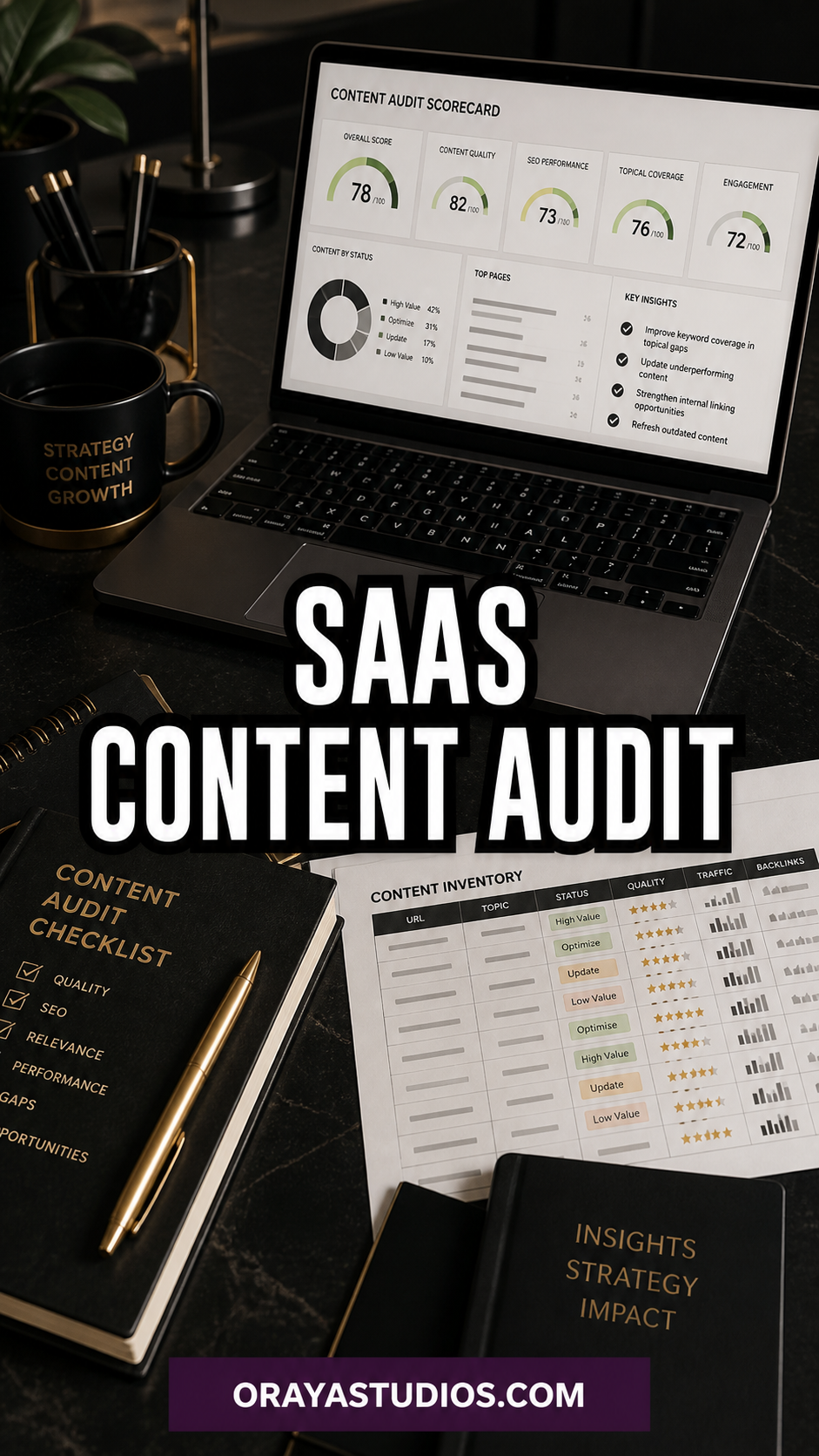
Quick answer: A 2026 SaaS content audit covers four categories: performance audit (which posts are ranking, which are declining, which are orphaned), quality audit (which posts are thin, outdated, or generic), strategic audit (which posts are in the wrong intent bucket or off-cluster), and AI citation audit (which posts are or are not being cited by ChatGPT, Claude, Perplexity, and Google AI Overviews). The output is a prioritized action list: refresh, consolidate, redirect, or delete. Backlinko has documented meaningful traffic lifts from running a content audit on the brand’s own blog. Most B2B SaaS content libraries built before 2024 contain 20 to 40% of pages that should be refreshed or consolidated; the audit is the cheapest single intervention to recover the lost performance.
Most B2B SaaS content libraries facing a SaaS content audit have a quiet problem: 20 to 40% of published posts are not contributing to the program. They rank for queries nobody searches, they target keywords the SaaS cannot plausibly own, they duplicate or cannibalize each other, or they were written in 2022 with stats nobody trusts in 2026. The library looks impressive in volume; the actual contribution to rankings, citations, and pipeline is concentrated in a much smaller share.
The content audit is the discipline that surfaces the gap and produces an action plan. The audit is also where most B2B SaaS recover the most value per hour of work: a single 90-day audit cycle typically produces 30 to 60% of the rankings recovery available from the entire content library, at a fraction of the cost of writing new content. This guide breaks down the four-category audit framework, the action categories the audit produces (refresh, consolidate, redirect, delete), and the cadence that keeps the library healthy.
Want a professional content audit of your B2B SaaS blog?
Oraya Studios runs B2B SaaS SEO audits that document the specific pages costing pipeline, the consolidation opportunities, and the refresh priorities. Output is a prioritized action plan within 14 days.
Recommended reads from this site
- SEO content marketing for B2B SaaS strategy guide
- Why most SaaS blogs fail
- Internal linking for SaaS content
- Keyword research for B2B SaaS
- How to measure SEO content marketing ROI
Why a SaaS content audit matters more than new content for most B2B SaaS in 2026
The default response to underperforming content programs is to write more content. The math usually argues for the opposite. A B2B SaaS with 200 published posts and 30 to 40% underperformers has 60 to 80 posts where refresh or consolidation will produce more rankings recovery than 60 to 80 net-new posts written from scratch.
Two reasons the math favors auditing over writing for most $1M to $15M ARR (annual recurring revenue) SaaS in 2026.
Reason one: existing posts already have age, indexing, and partial authority that new posts have to build from zero. A 2022 post ranking on page 2 of search can usually be moved to page 1 with 4 to 8 hours of refresh work; the same ranking lift on a net-new post typically requires 16 to 24 hours of writing plus 6 to 12 months of indexing and authority compounding. The refresh path is 4 to 6 times more efficient when the existing post has the foundation.
Reason two: the 2024 to 2026 algorithm shifts (AI Overviews, helpful content updates, AI engine citation) reset the rules for what content ranks. Most pre-2024 content was written for SERPs that no longer exist. A refresh that updates the content for 2026 SERP economics often produces materially better performance than a new piece on the same topic, because the refresh inherits the existing indexing and link equity while adopting the new structural requirements.
The exception: SaaS with content libraries under 30 posts usually need to invest in writing before auditing. The library is too small to have meaningful refresh opportunities. The audit framework starts to apply meaningfully around 50 published posts and becomes the dominant content investment around 150 to 200 posts.
Category 1: Performance audit
The performance audit categorizes every post by its current contribution to the content program. The four tiers map cleanly to action recommendations.
Tier one: top performers. The 10 to 20% of posts producing 60 to 80% of traffic, rankings, or pipeline contribution. The action is preserve and protect: refresh these annually, add new internal links to them, and prioritize them for AI citation optimization.
Tier two: solid performers. Posts ranking on page 1-2 for their target keywords with meaningful traffic but room for improvement. The action is refresh: update the content for 2026, add new sections that close gaps surfaced by SERP analysis, refresh the internal-link plan, and republish.
Tier three: underperformers. Posts ranking on page 3+ or with very low traffic despite being published 12+ months ago. The action depends on the post’s strategic fit. If the post targets a valuable keyword the SaaS can plausibly own, refresh aggressively (often a full rewrite). If the post targets a keyword the SaaS cannot plausibly own (competitive plausibility check fails), consolidate into a better-fitting post or delete.
Tier four: orphans and zombies. Posts with zero traffic, zero rankings, and zero internal links pointing to them. The action is usually delete or consolidate. Keeping zombie content drags the average quality signal of the site, which now affects ranking algorithms more directly than it did pre-2023.
Category 2: Quality audit
The quality audit looks at content quality at the post level, independent of current performance. The audit catches posts that perform okay despite quality problems (which will likely decline) and posts that should perform better than they do (because the quality is acceptable but other variables are dragging performance).
Three quality dimensions matter most for B2B SaaS content in 2026.
Dimension one: thin content. Posts under 800 words on competitive keywords almost always underperform. The 2026 minimum effective word count for ranking on competitive B2B SaaS keywords is 1,500 to 2,000 words. Thin posts should be either expanded substantially or consolidated into longer pieces.
Dimension two: outdated content. Posts citing 2022 stats, referencing tools that have been renamed or discontinued, or using examples from defunct companies signal staleness. The 2024 to 2026 helpful content algorithm shifts now penalize stale content more aggressively, and human readers (and AI engines) treat stale references as quality flags.
Dimension three: generic content. Posts that could appear on any SaaS blog without modification, that lack original data or named-expert sourcing, or that read as AI-generated without editorial intervention. The 2026 algorithms and AI citation patterns reward proprietary insight and original sourcing; generic content loses ranking ground each quarter.
Category 3: Strategic audit
The strategic audit looks at the content library against the SaaS’s current strategy, not the strategy when each post was written. Most B2B SaaS strategies shifted between 2022 and 2026, and the content library usually reflects the old strategy rather than the new one.
Three strategic mismatches to look for.
Mismatch one: wrong intent bucket. Posts targeting informational keywords that should be targeting commercial-investigation keywords given the SaaS’s current ICP (ideal customer profile) focus. Common when the SaaS originally targeted a broader audience and then narrowed to a specific vertical or buyer profile. The action is usually to refresh the post toward the new intent or to write a parallel commercial-intent post that links to the informational one.
Mismatch two: off-cluster content. Posts that do not belong to any of the SaaS’s currently-prioritized content clusters. These are usually historical pieces from earlier strategy iterations. The action is to either bring the post into an existing cluster through refresh and internal linking, or accept that the post is no longer strategically aligned and delete or noindex it.
Mismatch three: ICP drift. Posts whose target reader does not match the current ICP. A SaaS that originally targeted small business owners and now sells to mid-market RevOps leaders has a content library mostly written for the wrong audience. The action requires a strategic decision: invest in refreshing the legacy content toward the new ICP, or accept the legacy content as topic-cluster filler that will not convert against the new ICP.
Want the audit to surface the specific strategic mismatches in your library?
Oraya Studios audits include strategic mismatch analysis tied to the SaaS’s current ICP and go-to-market focus. The output specifies which posts to refresh, consolidate, or retire.
Category 4: AI citation audit
The AI citation audit is the newest of the four categories and the one most B2B SaaS skip entirely. The audit assesses which posts are being cited by ChatGPT, Claude, Perplexity, and Google AI Overviews, and which posts have the structural elements to start getting cited.
Read this also: AI Citation Statistics
The audit method: query the target AI engines with the SaaS’s top 30 to 50 priority keywords, observe which posts are cited (or whether competitors are cited instead), and identify the structural elements driving the citation gap.
The structural elements that drive AI citation in 2026: clean Quick Answer block at the top of the post (50 to 90 words), FAQ schema markup with 4 to 7 questions, named-source citation density (one citation per 200 to 300 words), original data or proprietary research, structured comparison tables for commercial-investigation content, and definitional precision in the opening section.
Most pre-2024 B2B SaaS content lacks the structural elements that drive AI citation. The audit identifies the gap, and the refresh adds the elements without rewriting the underlying content. Profound’s 2025 data showed Ramp grew AI brand mentions 7x in 90 days primarily through restructuring existing content for citation, not through writing new pieces. The audit-and-refresh path captures most of the AI citation upside without the cost of new content production.
The action categories: refresh, consolidate, redirect, delete
The audit produces an action recommendation for every post in the library. Four action categories cover most cases.
Refresh: update the content for 2026 (current stats, current tooling references, current SERP analysis), add the AI citation structural elements (Quick Answer block, FAQ schema, citation density), update internal-link plans, and republish. Refresh typically takes 4 to 8 hours per post and applies to roughly 40 to 60% of posts in a typical audit.
Consolidate: merge two or more thin posts on overlapping topics into a single deeper post. Implement 301 redirects from the consolidated URLs to the surviving URL. The 301 redirects preserve the link equity and the indexing history. Consolidation typically applies to 10 to 20% of posts in a typical audit and produces some of the highest ranking lifts because the consolidated post inherits the combined authority of the merged pieces.
Redirect: 301 redirect a post that should not exist anymore (off-strategy, off-ICP, or duplicating better content) to the nearest topically relevant alternative. The redirect preserves the SEO equity that would otherwise be lost to a delete. Typically applies to 5 to 15% of posts.
Delete: remove the post entirely (with appropriate 410 or 404 status, no redirect). Reserved for posts with no salvageable authority, no relevant topical home, and no link equity worth preserving. Typically applies to 5 to 15% of posts, mostly zombie content with zero inbound links and zero rankings.
The quarterly audit cadence (or annual, for smaller libraries)
The cadence depends on library size. Three patterns work.
Libraries under 50 posts: annual full audit. The library is small enough to audit comprehensively in one pass and the volume of changes does not require quarterly attention.
Libraries 50 to 200 posts: semi-annual full audit, with a monthly performance check focused on tier-one posts (the top 10 to 20%). The semi-annual cadence catches the strategic and quality issues; the monthly check protects the top performers.
Libraries over 200 posts: quarterly category-rotation audit. Each quarter audits one of the four categories (performance, quality, strategic, AI citation) across the full library, plus an ongoing monthly tier-one review. The rotation prevents the audit from becoming a 40-hour quarterly project.
The discipline that matters: the audit must produce a written action plan with specific posts, specific actions, specific due dates, and a single owner accountable for execution. Audits that produce strategic insights without action plans typically do not get executed; the library drifts back to the pre-audit state within 6 months.
Want the audit framework run on your existing content library?
Oraya Studios SEO audits deliver the prioritized action plan within 14 days. The audit includes performance, quality, strategic, and AI citation passes across the full library.
Frequently asked questions
How often should B2B SaaS run a content audit?
Annual for libraries under 50 posts. Semi-annual for libraries 50-200 posts. Quarterly category-rotation for libraries over 200 posts. The cadence matters because content libraries decay continuously: links break, stats go stale, competitor coverage improves, algorithm shifts change the ranking requirements. Without regular auditing, the underperforming share of the library grows from 20-30% to 50-60% within 18-24 months.
What is the difference between refreshing a post and rewriting a post?
Refreshing keeps the post’s URL, its existing rankings, and most of its structure, while updating 30-50% of the content for 2026 relevance. Rewriting keeps the URL but replaces 70-100% of the content. The refresh path is faster (4-8 hours per post) and lower-risk because the existing rankings are preserved. The rewrite path is slower (12-20 hours per post) and higher-risk because the rewrite can disrupt existing rankings temporarily, but produces better long-term performance for posts with strong keyword targets but weak existing content.
How do I decide whether to consolidate two posts or keep them separate?
Consolidate when: the two posts target the same search intent and similar keywords; the SERP shows Google ranking similar pages for both queries; the posts cannibalize each other (one ranks page 5, the other ranks page 7 instead of one ranking page 1). Keep separate when: the two posts target distinctly different search intents even if the topics overlap; the posts cover different stages of the buyer journey; the posts each rank for different keyword sets without cannibalization. The decision usually requires looking at the actual SERPs for each post’s target keywords.
Should B2B SaaS delete posts that have any traffic, even low traffic?
Generally no. Even low-traffic posts contribute small amounts of authority and link equity that affect the overall site signal. The exception: posts that target the wrong ICP, contain factually wrong information that cannot be efficiently corrected, or actively confuse the topical clustering of the site. For these, deletion (or 301 redirect to a topically relevant alternative) usually improves the site signal more than the small traffic loss costs.
Can a content audit help recover traffic lost to AI Overviews?
Yes, partially. The audit’s AI citation pass identifies posts that should be restructured to be cited inside AI Overviews rather than competing for clicks below them. The restructuring (Quick Answer blocks, FAQ schema, citation density, original data) typically recovers 30-50% of the lost click-through value through citation visibility and brand mention growth. The full recovery requires both the content restructuring and a strategic shift toward keyword types AI Overviews do not dominate (commercial-investigation and transactional intent keywords).
Key Takeaways
- Most B2B SaaS content libraries built before 2024 contain 20-40% of pages that should be refreshed or consolidated. The audit is the cheapest single intervention to recover the lost performance (Backlinko has documented meaningful traffic lifts from systematic content audits).
- The four audit categories: performance (which posts are contributing), quality (which posts are thin or stale), strategic (which posts are off-cluster or off-ICP), AI citation (which posts have the structural elements to be cited by AI engines).
- Four action outcomes: refresh (40-60% of posts), consolidate (10-20%), redirect (5-15%), delete (5-15%).
- Refresh is usually 4-6x more efficient than writing new content for ranking lift, because the existing post has age, indexing, and partial authority that new content has to build from zero.
- AI citation audits matter in 2026: Ramp grew AI brand mentions 7x in 90 days primarily through restructuring existing content for citation (Profound, 2025), not through writing new content.
- The discipline that compounds: every audit produces a written action plan with specific posts, actions, due dates, and a single accountable owner. Audits without action plans rarely get executed.
Wrapping up
The B2B SaaS content audit is one of the few content disciplines where the ROI math is decisively asymmetric in favor of investment: a 16 to 40 hour audit cycle typically produces 30 to 60% of the rankings recovery available from the entire content library, at a fraction of the cost of writing new content. The math holds across most $1M to $15M ARR SaaS with content libraries above 100 posts.
The teams that hold the audit discipline see content marketing perform predictably across years. The teams that skip auditing in favor of always writing new content typically see content libraries grow large and underperformance grow proportionally. The asymmetry is structural: writing new content is more exciting; auditing existing content produces better results per hour invested.
For B2B SaaS in the $1M to $15M ARR band running content programs that feel stuck or unable to defend budget at the CFO level, the audit is usually the highest-return single intervention available. The diagnostic surfaces the specific 30 to 80 posts costing the most ranking opportunity, the consolidation opportunities producing the largest lifts, and the AI citation gaps that explain why the program is not capturing the 2026 search economics. The action plan is concrete, and the work is mostly editorial refresh that the existing content team can execute.