
There is no universal “good” number for Pinterest impressions because it depends entirely on your niche, account age, and content volume. A new account with 1,000 to 10,000 monthly impressions is on track. An established blog-driven account typically sees 50,000 to 500,000 or more. What matters most is not the raw impression count but the save rate and click-through rate that follow from those impressions.
You open your Pinterest analytics and stare at the impressions number. Is it good? Is it terrible? Should you be panicking or celebrating?
Impressions are one of the most misunderstood metrics on Pinterest. People fixate on the number, compare it to accounts with completely different content volumes and niche sizes, and then make strategic decisions based on a comparison that does not mean anything. This post breaks down what impressions actually tell you, what benchmarks are reasonable at different account stages, and when to care about them versus when to look at something else.
Confused by your Pinterest analytics?
The Pinterest Analytics Decoder breaks down every metric in your dashboard so you know exactly what to look at, what it means, and what to do next. No more staring at numbers and guessing. Get the Analytics Decoder →
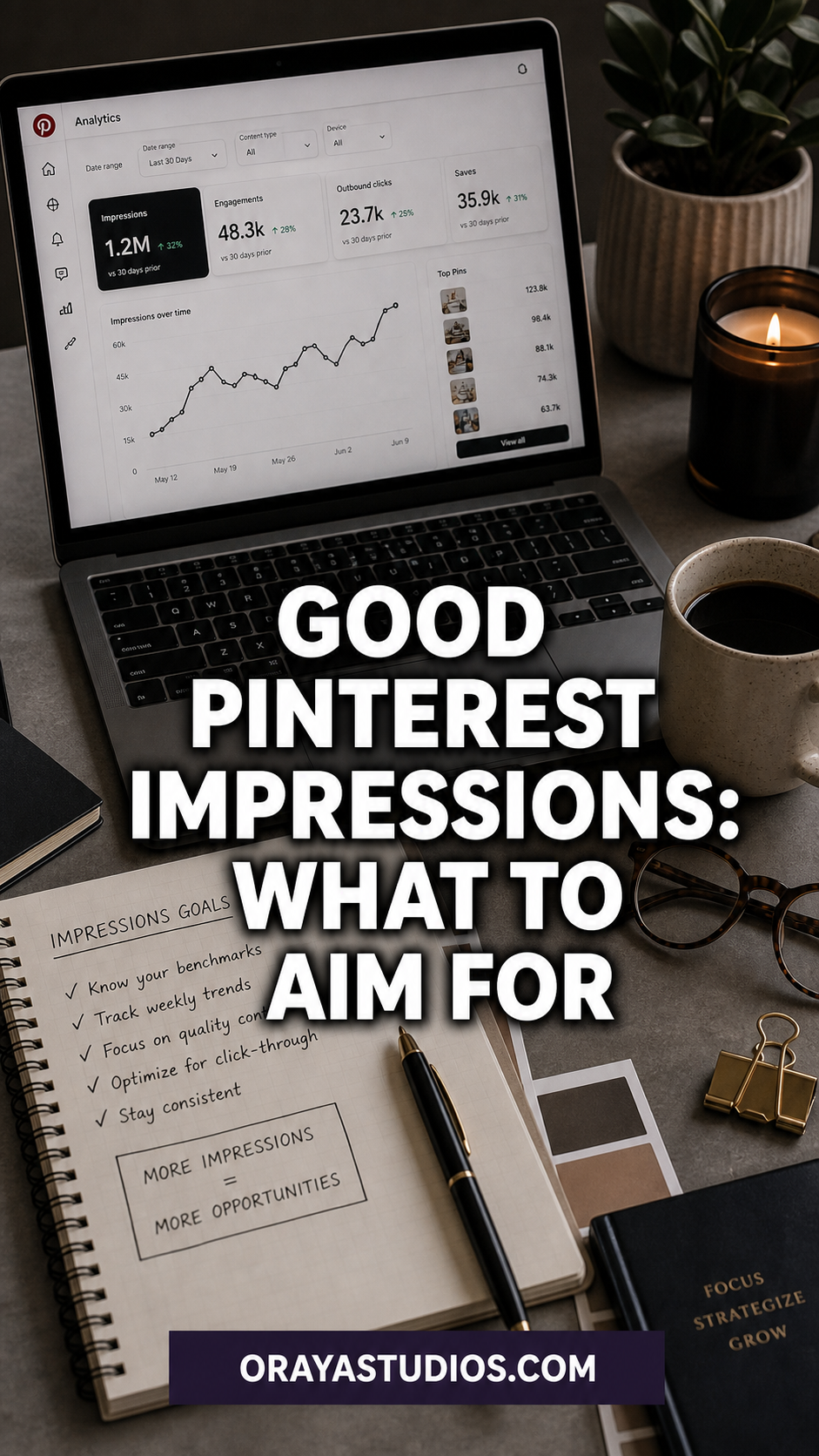
What Pinterest Impressions Actually Measure
A Pinterest impression is counted every time your pin appears on someone’s screen. That includes home feed appearances, search results, related pin recommendations, and board views. Impressions tell you how often Pinterest is distributing your content.
What impressions do not tell you: whether anyone looked at the pin, clicked on it, saved it, or found it useful. A pin with one million impressions and zero saves is getting distributed widely and connecting with nobody. A pin with 200 impressions and 40 saves is hitting a small but highly relevant audience who finds it genuinely valuable.
This distinction matters because the most common Pinterest mistake is optimizing for impressions rather than the metrics that actually predict traffic and revenue. Pinterest engagement metrics like saves and clicks are the numbers that tell you whether your strategy is working.
What is a Good Number of Pinterest Impressions?
Because impressions scale with content volume, niche size, and account age, there is no single benchmark that applies to every account. Here is a rough guide by account stage:
New account (0 to 6 months)
1,000 to 25,000 monthly impressions is a normal range. Pinterest is still evaluating your account quality and content consistency. Focus on building a foundation of well-optimized pins and boards rather than chasing impression numbers at this stage.
Growing account (6 to 18 months)
25,000 to 250,000 monthly impressions indicates the algorithm is starting to distribute your content more broadly. At this stage, you should be seeing consistent saves on your best-performing pins and some measurable traffic to your website.
Established account (18+ months)
250,000 to several million monthly impressions is typical for accounts with consistent publishing, strong keyword optimization, and a solid library of high-performing pins. Numbers vary wildly by niche. A personal finance account will look very different from a home decor account even with the same posting frequency.
The more useful question is not how many impressions you have but what your save rate and outbound click rate are. Those numbers tell you whether your impressions are converting into something that matters. An impression count going up while saves stay flat usually means you are reaching the wrong audience.
Monthly Viewers vs. Impressions: What Is the Difference?
Pinterest shows two numbers prominently on profiles: monthly viewers and, in the analytics dashboard, impressions. They are related but measure different things.
Monthly viewers counts unique accounts that saw any of your pins over the past 30 days. Impressions count total pin appearances, including multiple times from the same viewer. An account with 500,000 monthly viewers might have 2 million impressions if those viewers see your pins repeatedly.
Monthly viewers is the vanity metric that shows on public profiles. It looks impressive but tells you almost nothing about strategy. Impressions in the analytics dashboard is more useful for tracking distribution trends over time. Neither number tells you as much as saves and clicks.
Want a Pinterest strategy that goes beyond impressions?
The PinFlow Blueprint covers the full system: keyword optimization, pin design, board strategy, and how to track the metrics that actually drive traffic and revenue. Get the PinFlow Blueprint →
Why High Impressions Do Not Always Mean Good Results
It is possible to have millions of impressions and almost no website traffic. This happens for a few reasons:
- Your pins are getting distributed in broad, low-intent feeds where people scroll passively rather than search with intent to click
- Your pin design is eye-catching enough to get an impression but the title and description do not give people a clear reason to click through to your website
- Your content is ranking for keywords that attract people who save the pin for inspiration but never intend to visit the source
- Your landing pages are slow, broken, or do not deliver what the pin promised, causing people to click once and not return
- You are in a niche where Pinterest users browse heavily but buy or read elsewhere
If your impressions are healthy but traffic is not following, the fix is usually in your keyword targeting and pin title specificity rather than in posting more content.
How to Improve Your Pinterest Impressions
If your impressions are genuinely low and you want to grow them, here is what moves the number:
- Post consistently. Pinterest rewards accounts that publish regularly. Even 5 to 10 well-optimized pins per day consistently will outperform sporadic high-volume posting
- Fix your keyword optimization. Pins without clear keywords in titles and descriptions do not get placed in search results. Check your top 10 pins and verify that every one has a keyword-rich title
- Create multiple pins per post. Each pin design is a new entry point to your content. 3 to 5 pin designs per blog post, spread out over several weeks, multiplies your impression opportunities without requiring new content
- Improve your save rate. Pinterest distributes content that gets saved more broadly. A higher save rate on existing pins is the fastest path to improving impressions on new pins
- Publish in high-traffic seasons. Pinterest has seasonal traffic patterns. Publishing holiday and seasonal content 6 to 8 weeks ahead of peak season gives pins time to gain traction before the traffic surge
When Low Impressions Are Actually Fine
Some accounts have intentionally small, highly targeted audiences on Pinterest and that is completely by design. If you are in a very narrow niche, your monthly impression ceiling is simply lower than a broad lifestyle account. That does not mean your strategy is failing.
If your 50,000 impressions per month are driving 2,000 website sessions with solid engagement, and your 2,000 Pinterest sessions are converting to email subscribers or purchases, your Pinterest strategy is working well. Context is everything. Chasing big impression numbers is one of the myths that leads creators to optimize for the wrong outcome.
Is your Pinterest profile fully optimized?
Run through the free Pinterest SEO Checklist to make sure your profile, boards, and pin descriptions are all set up to maximize distribution from every pin you publish. Get the free checklist →
Frequently Asked Questions About Pinterest Impressions
How many Pinterest impressions per month is good?
It depends on your account age and niche. New accounts getting 1,000 to 25,000 impressions per month are developing normally. Established accounts typically see 100,000 or more. The save rate is a more meaningful benchmark than the raw impression number.
Why did my Pinterest impressions suddenly drop?
Impression drops usually happen after a period of inactivity, after Pinterest algorithm updates, or when your content falls out of seasonal relevance. Check whether the drop is across all pins or isolated to specific ones. A targeted drop usually points to content quality or keyword issues; a broad drop often means posting frequency or consistency has changed.
Do Pinterest impressions affect SEO?
Pinterest impressions do not directly affect Google or other search engine rankings. However, if your Pinterest pins drive traffic to your website and those visitors engage with your content, that activity can have indirect positive effects on your broader SEO signals over time.
Should I try to get a million Pinterest impressions?
Only if that traffic converts into something meaningful for your business. A million impressions with a 0.1% click-through rate gives you 1,000 website visits. A focused strategy with 100,000 impressions and a 2% click-through rate gives you 2,000 visits from a more targeted audience. Quality of reach matters more than quantity.
Key Takeaways
- Impressions count how many times your pins appeared on screen. They measure reach, not engagement or results
- New accounts getting 1,000 to 25,000 monthly impressions are on a normal growth track. Established accounts see 100,000 or more
- Save rate and outbound click rate are more useful benchmarks than raw impression counts
- High impressions with low traffic usually means keyword or title specificity issues, not a reach problem
- Improve impressions by posting consistently, optimizing keywords, and creating multiple pin designs per post
- Low impressions in a narrow niche can still produce excellent results if the traffic that comes through converts well
Wrapping Up
Impressions are a useful signal when read in context, and a misleading one when treated as the primary goal. They tell you whether Pinterest is distributing your content. Saves tell you whether people find it worth returning to. Clicks tell you whether it is sending traffic to your site.
Check your impressions for trend direction (growing, stable, declining) and pair them with your save and click data to understand the full picture. Understanding how to read your Pinterest analytics properly is what turns data into decisions.