
Quick answer: Fractional content marketing and B2B SaaS content marketing agencies serve different functions and are usually complements, not substitutes. Fractional content marketing buys strategic depth from a single senior practitioner at 10 to 20 hours per week ($3K to $10K per month). A content marketing agency buys execution capacity from a team of writers and editors managing a specific scope ($4K to $15K per month for typical retainers). Most successful B2B SaaS in the $5M to $15M ARR (annual recurring revenue) band run both: the fractional sets strategy and writes briefs, the agency produces the content against those briefs.
The “fractional CMO vs marketing agency” framing is one of the most common false binaries in B2B SaaS marketing decisions. Founders evaluate the two as if they replace each other, then end up with a configuration that solves one half of the problem and leaves the other half exposed. The honest answer is that fractional and agency cover different layers of the content function and the right configuration usually uses both.
This guide breaks down where each model fits, when one replaces the other, and the failure patterns to avoid.
Considering fractional or agency for your SaaS content function?
Oraya Studios runs fractional content marketing built specifically for B2B SaaS. The model coordinates with content production agencies or in-house writers depending on your existing infrastructure.
Recommended reads from this site
- What is fractional content marketing
- Fractional CMO cost breakdown
- In-house vs agency vs fractional comparison
- Evaluating a B2B SaaS content agency
- SEO + GEO content marketing for SaaS
| Dimension | Fractional Content Marketing | Marketing Agency |
|---|---|---|
| Scope | Strategic depth, content-only | Execution capacity, team-based |
| Cost | $3K-$10K/mo | $4K-$15K/mo |
| Hours per week | 10-20 of one senior practitioner | Distributed across a team |
| Best fit | $1M-$15M ARR needing strategy | Established orgs needing volume |
| Brand voice retention | High (single practitioner) | Variable (multiple writers) |
| Time to start | 2-4 weeks | 2-4 weeks |
Cost-effectiveness: fractional vs agency for senior strategy
Fractional content marketing , ~$6,500/mo (single senior practitioner)
Equivalent agency strategic tier , ~$12,000/mo for similar senior depth
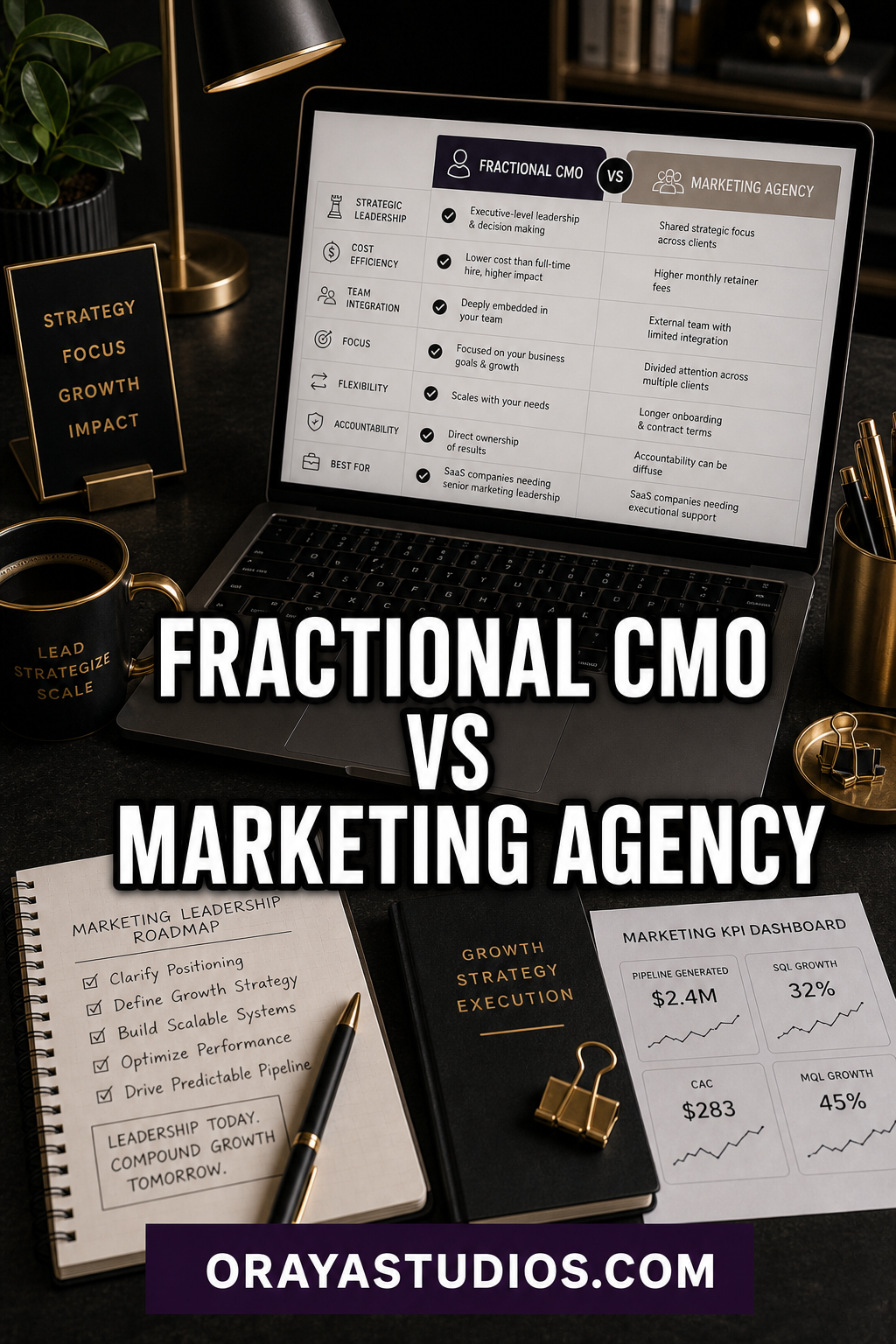
Fractional CMO vs marketing agency: the fundamental difference
Fractional content marketing buys one senior practitioner part-time. The output is strategic: keyword universe, content calendar, briefs, editorial oversight, performance attribution. The fractional thinks deeply about a small number of decisions per week and the seniority shows up in the brief quality.
Read this also: When to Hire a Fractional CMO
A content marketing agency buys an execution team. The output is operational: produced blog posts, white papers, case studies, ebooks, and whatever else the scope of work covers. The agency thinks at scale about producing many pieces of content per month and the structural advantage shows up in the velocity.
Both layers are necessary. A SaaS with brilliant strategic depth and no execution capacity publishes one post per quarter and watches the calendar fill with backlog. A SaaS with brilliant execution capacity and no strategic depth publishes a steady stream of forgettable content that ranks for nothing and converts nobody. The function works when both layers are in place and coordinated.
Side-by-side comparison across seven dimensions
1. Scope and deliverable type
Fractional: strategy documents, briefs, editorial notes, performance reports, quarterly strategy resets. Output is the thinking behind the content.
Agency: produced articles, designed graphics, case studies, sometimes paid distribution. Output is the content itself.
2. Cost structure
Fractional: $3,000 to $10,000 per month for 10 to 20 hours per week of senior practitioner time. The cost is the time of a single person.
Agency: $4,000 to $15,000 per month for typical B2B SaaS content retainers, with project-based work running $2,000 to $8,000 per asset for case studies and white papers. The cost is the output volume of a team.
3. Seniority of the people doing the work
Fractional: typically 8 to 15 years of experience, often having led content at one or two B2B SaaS companies before. The senior practitioner is doing the work directly.
Agency: mixed seniority team. A senior strategist or account director sets direction (typically 6 to 12 years of experience), and a team of writers (2 to 8 years of experience) executes. The senior person is rarely doing the daily writing.
4. Context retention and continuity
Fractional: deep context retention. The same person reviews every brief, every post, every performance report for the duration of the engagement. Context compounds over months and shows up in increasingly sharper strategic recommendations.
Agency: variable context retention. The strategist sets the direction once, then the writing team executes against it. When writers churn out of the agency, the new writer assigned to your account needs to rebuild context from the brief alone. This is one of the most common friction points in agency engagements.
5. Capacity scalability
Fractional: cannot scale meaningfully. A fractional working 15 hours per week can write four briefs per week and review four posts per week. Beyond that, the engagement needs to add hours or add a second fractional.
Agency: scales easily. An agency can take a 4-post-per-month retainer and a 20-post-per-month retainer with the same client team simply by allocating more writers. This is the agency model’s structural advantage when execution volume is the bottleneck.
6. Brand voice consistency
Fractional: high brand voice consistency. One person is reviewing every brief and every post, which means the voice gets coherent quickly and stays coherent.
Agency: lower brand voice consistency unless explicitly managed. Different writers produce different voices, and the editorial layer in most agencies is not deep enough to fully normalize them. Founders frequently complain that agency-produced content “sounds different” across articles, which usually traces to multiple writers without strong editorial enforcement.
7. Strategic flexibility
Fractional: flexible. The same senior practitioner can pivot mid-quarter when the data shows the strategy needs to change. Strategy adjustments happen in real time during weekly check-ins.
Agency: less flexible. Mid-quarter pivots require renegotiating the scope of work, often through the account manager, with the new direction trickling down to the writing team. Pivots take 2 to 4 weeks to fully reflect in produced content.
Want to scope what a fractional plus agency configuration would look like for your SaaS?
Book a discovery call to walk through your current content infrastructure. Oraya Studios scopes fractional content marketing engagements that coordinate cleanly with content production agencies or in-house writers.
When fractional alone is the right call
Two configurations work with fractional alone, without an agency or in-house writers.
Read this also: When NOT to Hire a Fractional CMO
Configuration one: the SaaS already has internal writers. One or two full-time content writers in-house, plus a fractional content marketer setting strategy and writing briefs, is one of the highest-return configurations in B2B SaaS content marketing. The fractional brings senior strategic depth at 15 hours per week; the writers bring full-time velocity at $80K to $130K each per year. The total cost is $130K to $220K per year all-in, and the output exceeds most agency retainers at twice the cost.
Configuration two: the SaaS is testing whether content is the right investment. Hiring a fractional for 3 to 6 months to write briefs that the SaaS executes against contracted writers (paying per post) is the cleanest way to validate whether content marketing should be funded at scale. If the early posts rank and contribute pipeline, the SaaS expands. If not, the engagement can pivot or wind down at a much lower cost than a full agency commitment.
60-70%
of B2B SaaS at $1M-$15M ARR running on the dual configuration of fractional content marketing for strategy + agency for execution capacity. Most converge here whether they planned to or not.
Source: Oraya Studios observation across client engagements, 2026
When agency alone is the right call
Three configurations work with agency alone, without a fractional content marketer in the picture.
Read this also: SEO Agency vs In-House
Configuration one: the founder is doing the strategic content work personally. Some SaaS founders are content experts (former SaaS marketers, former agency founders, former B2B content writers themselves) who want to own strategy directly. In that case, the agency executes against the founder’s briefs, and the fractional layer is redundant. The configuration works only when the founder genuinely has the time and skill to set strategy at the same depth a fractional would, which is rare past $3M ARR.
Configuration two: the SaaS has a full-time content director already. The content director sets strategy and the agency executes against it. Adding a fractional in this configuration creates confused ownership and slows decision velocity. The agency is the right complement to a full-time content director, not a fractional.
Configuration three: the scope is narrow and project-based. A SaaS commissioning a specific deliverable (a white paper, a case study series, a research report) does not need fractional strategic depth on retainer. A specialist agency or a senior freelance writer can handle the work directly, with the founder providing the strategic input.
When both are the right call
The most common winning configuration for B2B SaaS at $3M to $15M ARR uses both fractional content marketing and a content production agency in parallel.
The fractional sets the quarterly strategy, builds the keyword universe, writes the briefs, and reviews the agency’s output before publication. The agency takes the briefs, produces the posts, handles the on-page formatting, and delivers the published-ready files. The fractional’s monthly performance review feeds back into the agency’s content calendar for the following month.
The cost structure works out to roughly $8,000 to $13,000 per month for the fractional plus $5,000 to $12,000 per month for the agency, with the SaaS getting both deep strategic ownership and consistent execution velocity. Most B2B SaaS in this band that hit content benchmarks (700 to 1,100% ROI, or return on investment, over 24 to 36 months per Averi AI, 2026) run this dual configuration.
Failure patterns to avoid
Three patterns consistently produce underwhelming content programs and are worth recognizing before they happen.
Pattern one: agency-only engagement with vague brand direction. Most B2B SaaS that hire an agency without first defining the brand voice, the ICP language, and the content strategy end up with generic, well-written, forgettable posts. The agency is doing what it can with the brief it received, but the brief itself was thin. The fix is either a fractional layer to deepen the briefs or a content director to own the strategic input internally. Adding more agency hours does not fix the problem.
Pattern two: fractional-only engagement with no execution capacity. A SaaS hires a fractional for $6,000 per month, gets brilliant briefs, then has no one to write the posts. The founder ends up writing them on weekends or finds inexperienced freelance writers who produce content that does not match the brief’s depth. The fix is either an agency or contracted writers to execute, or in-house writers to operationalize the briefs.
Pattern three: dual configuration with no coordination. The SaaS hires both a fractional and an agency but does not align them on workflow. The fractional writes briefs the agency does not use; the agency produces content the fractional has not reviewed; both bill the SaaS without producing the compounding output the configuration should deliver. The fix is explicit workflow documentation upfront and a single point of accountability (usually the fractional) for the strategic layer.
How to decide which configuration fits your SaaS
A clean decision rubric. Three questions sequentially identify the right configuration.
Question one: do you have a full-time content director or VP of marketing dedicated to content? If yes, agency alone usually works. If no, continue to question two.
Question two: do you have internal writers, in-house or contracted, who can produce 4 to 12 posts per month consistently? If yes, fractional alone (with the existing writers as execution layer) is the right configuration. If no, continue to question three.
Question three: what is the content budget you can sustain over 12 months? If under $5,000 per month, fractional alone with project-based contracted writers is the most efficient configuration. If $5,000 to $12,000 per month, agency alone with founder-led strategy is the cheaper of the two viable options. If above $12,000 per month, the dual configuration (fractional plus agency) delivers the highest compounding return.
Frequently asked questions
Can an agency provide fractional content marketing as a single bundled service?
Some can, but the structural conflict usually shows up in execution. An agency that provides both strategy and production has an economic incentive to recommend more production, because production is the more billable layer. A fractional working independently of an agency has no incentive to recommend more posts than the strategy justifies. Founders evaluating bundled offerings should ask whether the strategic layer is set by the same person who profits from the production layer; if the answer is yes, the conflict is real and worth pricing into the engagement decision.
Is it cheaper to hire a senior content writer in-house instead of fractional plus agency?
At $5M+ ARR, possibly. A senior in-house content writer at $120K to $160K base salary plus benefits is roughly $150K to $200K all-in annually, which is $12K to $17K per month. That is comparable to the fractional-plus-agency configuration but with the advantages of full-time dedication and brand voice consistency. The trade-off is that the in-house writer covers strategy plus execution at one person’s hour budget, which usually means strategy gets less attention than a dedicated fractional would provide. The right answer depends on whether the SaaS values brand voice consistency more or strategic depth more.
What is a typical content marketing agency retainer for B2B SaaS in 2026?
Most B2B SaaS content marketing agency retainers settle between $4,000 and $15,000 per month in 2026, with $7,000 to $10,000 being the most common band. The retainer typically covers 4 to 10 blog posts per month plus on-page SEO, internal linking, and sometimes design assets. Long-form deliverables (white papers, ebooks, case studies) usually run on top of the retainer at $2,000 to $8,000 per asset. Agencies positioning at the high end of the range often include strategic services that overlap with fractional content marketing, which is worth clarifying upfront.
Should I hire fractional and agency at the same time or sequence them?
Sequence them when possible. Start with fractional for the first 90 days to build the strategy, the keyword universe, and the initial briefs. Bring the agency in around month two or three with the strategy already documented, so the agency is executing against a real brief rather than figuring out direction in parallel. The sequential approach saves 4 to 8 weeks of confusion in the early months and produces a much cleaner ongoing workflow.
What is the difference between a content marketing agency and a SEO agency?
Content marketing agencies focus on creating content that builds audience and converts leads over time. SEO agencies focus on technical optimization, link building, and search ranking improvements, sometimes with content as a byproduct. The two functions overlap but lead with different priorities. B2B SaaS in 2026 usually needs both layers, but the budget allocation differs by stage. Earlier-stage SaaS prioritize content marketing agencies (or fractional content marketing); more mature SaaS that already have content depth prioritize SEO agencies for the technical layer.
“Most $5M-$15M ARR SaaS end up running both. The fractional sets strategy, the agency runs production. Trying to make one model do both jobs usually breaks one of them.”
Oraya Studios
Key Takeaways
- Fractional content marketing and content agencies serve different functions: strategic depth versus execution capacity (fractional CMO vs marketing agency, the real frame).
- Cost ranges: fractional $3K-$10K/mo for senior practitioner; agency $4K-$15K/mo for execution team.
- Fractional alone fits when internal writers handle execution. Agency alone fits when founder or full-time director owns strategy.
- The dual configuration (fractional plus agency) is the highest-return setup for most B2B SaaS at $3M-$15M ARR.
- Three failure patterns: agency-only with vague briefs, fractional-only without execution capacity, dual configuration without coordination.
- Sequence them when possible: fractional first to set strategy, then add agency once the strategy is documented.
Wrapping up
The fractional-versus-agency question usually resolves into a fractional-and-agency answer for most B2B SaaS at the right scaling stage. The two models are complements that solve different layers of the content function, not substitutes for each other.
Founders who set up the dual configuration correctly typically describe content marketing as one of the cleanest functional builds in the scaling phase. Founders who treat the two as mutually exclusive typically describe content marketing as the function that consistently underdelivered, even at high spend levels.
The decision rubric in this guide is the same one we apply to scope our own engagements. SaaS companies that already have execution capacity (internal writers or a steady agency) usually need only the fractional strategic layer. SaaS companies that have neither usually need both, with the fractional going first to build the strategic baseline.